
At a glance
01
Client
Al-Hadaf — an Iraqi recruitment platform founded in 2019
02
Industry
Recruitment & job placement
03
Scope
Public web platform (AR/EN) + admin panel + dedicated promoter app + payment gateway
04
Highlights
Invite-code referral attribution, in-app earnings wallet with withdrawals, Qi Card integration, offline-capable operation
The challenge
Al-Hadaf was running hundreds of job listings on paper.
Every opening that came in was written into a ledger: employer name, role, wage, headcount, location. Over months, those ledgers became an archive nobody could work with.
Loss. Paper degrades and goes missing, and with it the contact details of employers who reached out once and never came back.
Search. When a candidate arrived looking for work in a particular trade, staff had to page through hundreds of records to find out whether a match existed. Often it did — but nobody could surface it in time.
Follow-up. A job opening isn't static. An employer who needed five workers two months ago may have filled the role, doubled the request, or changed the wage. With no reminder system, follow-up depended entirely on staff memory.
But the hardest problem was elsewhere: promoter commissions.
The company works with a network of promoters who share its listings on social media, each earning a percentage for every person who comes through them and actually applies. Attribution relied on asking the applicant out loud: who told you about us? That answer gets forgotten, misremembered, and occasionally credited to the wrong person. The result was recurring disputes over who was owed what, and hours lost every month to manual reconciliation.
What we built
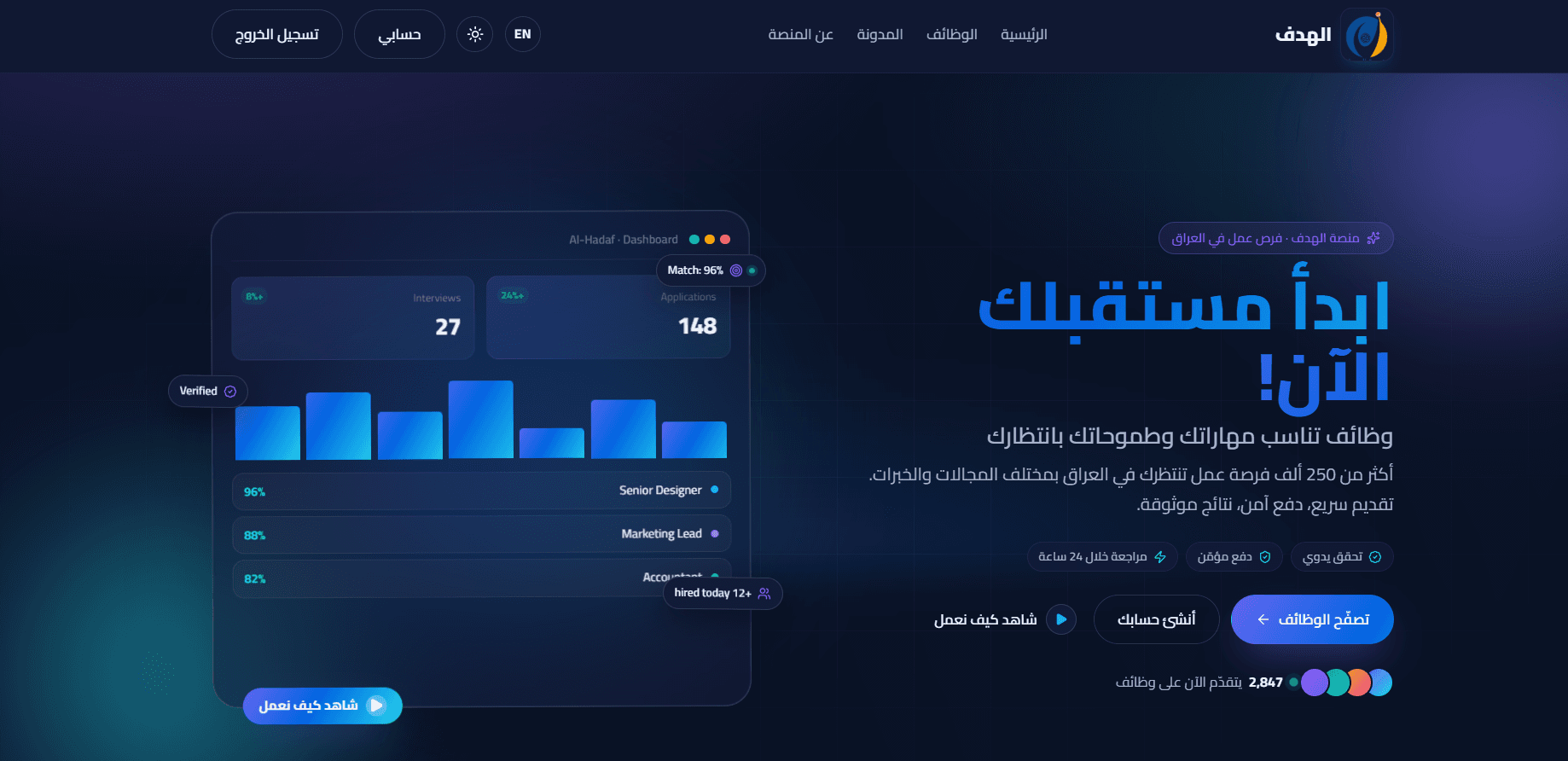
We delivered four layers: a public platform for job seekers, an admin panel where the team runs everything, a dedicated app for promoters, and the referral system tying them together.
1. The public platform
A bilingual site (Arabic and English) with light and dark modes, listing open positions with search and filtering by city and specialization. Each job has its own page showing wage, hours, location, and requirements, with a direct apply button.
Every job page also carries share buttons for WhatsApp, Telegram, and Facebook — not a cosmetic feature, as you'll see.
2. The admin panel
This is where the team lives day to day: full job management (creation, editing, categories, cities), promoter management, blog, forms, financial records, user permissions, and site settings.
Three decisions here are worth pausing on.
Search by phone number. In the Iraqi market, an employer's phone number is their real identity — not an email address, not a registered business name. So we made phone number a primary search field in the admin panel. When an employer calls, staff type the number and immediately see every listing that employer has ever posted. That small detail is what solved the follow-up problem.
Hide, don't delete. A filled position isn't deleted — it's hidden from the public site and kept in the archive. Employer data stays valuable after the opening closes: they may need workers again in two months, and an agency that deleted the record starts from zero.
Client-managed categories and cities. Job categories (restaurant, salon, driver, sales rep, accountant, nursery, factory) and cities are managed by the client's own team without coming back to us, because the labour market keeps producing new categories.
3. The promoter app — the real fix
Instead of asking applicants who referred them, we built promoters their own app and made the question irrelevant.
An invite code per promoter. Every registered promoter gets a personal code to hand out to the people they direct to the platform. When someone applies using that code, the referral is recorded on the spot — before anyone can intervene and before anyone can forget.
4. Qi Card payments
We integrated Qi Card because it's among the most widely used and trusted payment gateways in Iraq, and Iraqi users are far more comfortable with it than with foreign gateways requiring international cards. Because the market shifts, we built payment settings so the team can enable or disable any gateway — including manual payment — from the admin panel, with no code changes.
5. Offline operation
This is a feature you rarely see in international recruitment platforms, because they're built for markets that don't have our constraints. Connectivity loss is a daily reality in Iraq, and a recruitment agency can't stop working because the line dropped. The system was built so the team can keep working through it and sync afterwards.